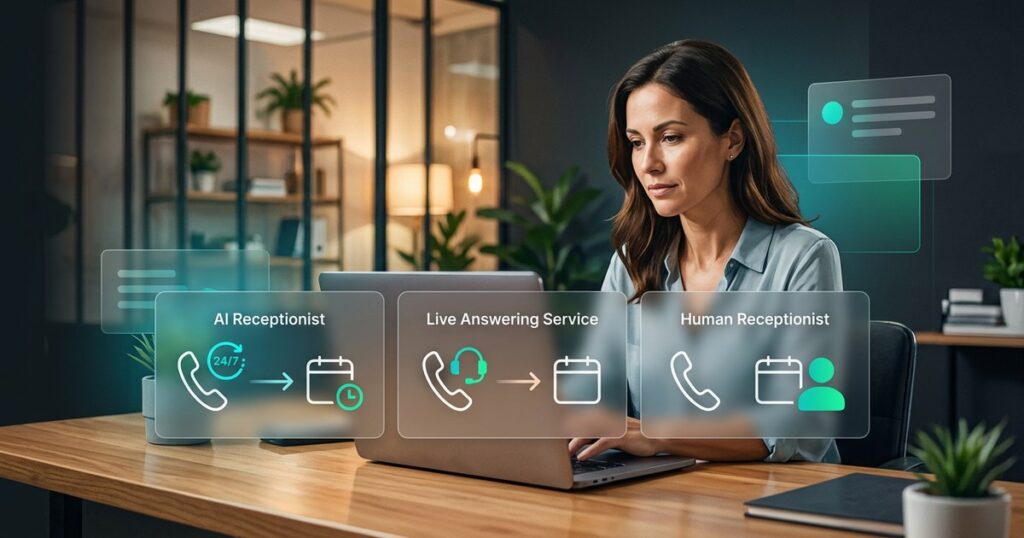
An AI receptionist for small business can answer routine calls, capture enquiries and support bookings when owners and staff are busy. Reception AI, based in Perth, gives small Australian businesses a practical way to improve responsiveness without expecting one person to monitor the telephone all day.
It provides a consistent first response while allowing the team to focus on customers, appointments and billable work.
Small businesses lose opportunities when calls go unanswered or follow-up details are incomplete. Reception AI can provide 24/7 call coverage, gather the right information and direct each enquiry appropriately. It works best when tailored to the individual business and supported by clear rules for human follow-up.
Why Do Missed Calls Cost Small Businesses More?
For a large organisation, an unanswered call may enter a queue or reach another department. In a small business, the call often arrives while the owner is driving, working with a customer, operating equipment or trying to finish an urgent task.
The caller may not leave a message. They may simply contact the next business shown in the Google search results.
Even when callers leave a voicemail, messages such as “Please call me back” give the team very little context. This creates another round of telephone tag and delays the response.
An AI receptionist responds at the moment of intent. It can ask why the person is calling, confirm their contact details and collect information that makes the next response more useful.
What Can Reception AI Handle for a Small Business?
Reception AI can be configured for specific call types rather than answering every caller in the same way.
Common uses include:
- New customer enquiries
- Quote or consultation requests
- Appointment requests
- Appointment changes or cancellations
- Service-area questions
- Opening hours and location information
- Basic service eligibility questions
- Existing customer messages
- Urgent issue identification
- Recruitment or supplier calls
- Requests that require a staff callback
The system should only answer from approved business information.
If the caller asks something outside that scope, Reception AI can explain that a team member will need to assist, collect the question and arrange the appropriate next step.
How Does an AI Receptionist Save Time?
The time saving comes from structure.
Instead of staff listening to vague voicemail messages, returning calls without context and manually rewriting notes, Reception AI can gather the same essential information every time.
For example, a service business may need:
- The caller’s name
- Contact number
- Email address
- Suburb or service location
- Type of work required
- Level of urgency
- Preferred appointment or callback time
A professional practice may need a more careful intake process involving privacy wording, conflict checks or restrictions on the information that can be provided.
When those requirements are mapped properly, the team receives a concise summary and knows what should happen next.
This reduces avoidable administration while preserving human attention for the actual service.
Which Small Businesses Benefit Most?
Reception AI can suit many businesses, but it is particularly useful where incoming calls arrive while people are completing hands-on work, attending appointments or speaking with existing customers.
Examples include:
- Trades and home-service businesses
- Real estate and property services
- Legal and professional practices
- Allied health and wellness providers
- Automotive and repair businesses
- Beauty salons and appointment-based services
- Consultants and small agencies
- Hospitality and accommodation providers
- Mobile service businesses
- Growing online and local retailers
The correct workflow differs for every industry.
A plumber may prioritise the caller’s location and the urgency of the problem. A real estate agency may need to distinguish a rental maintenance matter from a sales enquiry.
A family law firm must handle sensitive information carefully and avoid presenting general information as legal advice.
Reception AI should be configured around these differences rather than relying on one generic call script.
Can Reception AI Help Sole Traders?
Yes. Sole traders often have the greatest need for reliable call coverage because the person delivering the service is also responsible for answering enquiries.
A missed call may occur because the owner is:
- Driving between jobs
- Using tools or equipment
- Meeting a customer
- Attending an appointment
- Working in a noisy environment
- Taking a short break
- Speaking with another caller
- Managing paperwork after hours
Reception AI can greet the caller, determine why they are calling and collect the details required for a useful response.
The caller receives immediate acknowledgement, while the business owner can return the enquiry at a safe and appropriate time.
AI Receptionist, Voicemail or Another Staff Member?
Voicemail is simple and inexpensive, but it delays the interaction and depends on callers leaving useful details.
Hiring another staff member provides human flexibility, but it also involves recruitment, wages, training, leave coverage and set working hours.
A traditional call-answering service can provide personal contact, although the operator may have limited knowledge of the individual business.
Reception AI offers immediate and consistent handling for repeatable call types. It does not replace the judgement of a capable employee. Instead, it fills the coverage and information-gathering gap that causes many small teams to lose time and leads.
The decision should be based on actual call patterns rather than the novelty of the technology.
If the team repeatedly misses calls, answers the same questions or receives incomplete messages, an AI receptionist may solve a genuine operational problem.
Can an AI Receptionist Help Convert More Leads?
An AI receptionist cannot guarantee that every caller will become a customer. Pricing, availability, service suitability and the quality of the final human response still matter.
However, Reception AI can improve the opportunity to convert a lead by ensuring the caller receives an immediate response and the enquiry is captured accurately.
This is especially important for leads generated through:
- Google Search
- Google Ads
- Social media
- Online directories
- Website visits
- Referral campaigns
- Local marketing activities
A business may invest heavily in attracting enquiries, only to lose them when nobody answers the telephone.
Reception AI helps close the gap between generating attention and responding to the person who takes action.
What Does a Good Small-Business Setup Include?
A reliable Reception AI setup needs more than a greeting and a list of frequently asked questions.
It should include:
- A list of services the business provides.
- Services or requests the business does not handle.
- The suburbs, regions or service areas covered.
- Approved answers to common questions.
- The information required for each enquiry type.
- Clear definitions of urgent and emergency matters.
- Rules for call transfers, messages and callbacks.
- Realistic response-time expectations.
- A process for updating information when the business changes.
This business-specific preparation is what turns a general voice tool into a useful reception process.
A Five-Call Test for Your Business
Review the last five incoming calls your team missed.
For each call, ask:
- Did the caller leave a message?
- Did the message include enough information?
- How long did it take to return the call?
- Was the caller still looking for help?
- Did the caller eventually become a customer?
- Could Reception AI have handled the first stage?
- What information would have made the follow-up easier?
This provides a more realistic measure of potential value than focusing only on the total number of calls.
One missed high-value enquiry may matter more than many routine calls.
Will Reception AI Sound Like Our Business?
It should.
Reception AI can be configured to use the organisation’s preferred terminology, tone and questions.
A relaxed local service business may want a friendly and conversational style. A legal or professional practice may require a measured and more formal approach. A busy trade business may prefer the conversation to be direct and efficient.
Consistency is equally important. Callers should receive the same approved explanation regardless of when they call.
When a human response is required, Reception AI should say so plainly and arrange the next action rather than attempting to answer beyond its approved knowledge.
What Happens When a Caller Asks an Unexpected Question?
No knowledge base can predict every question a caller might ask.
When Reception AI receives a question outside its approved scope, it should not guess or create an answer. It can explain that the appropriate team member will need to assist, collect the question and follow the agreed callback or message process.
These unanswered questions can also improve the service over time.
If multiple callers ask the same question, the business can decide whether an approved answer should be added to the Reception AI knowledge base or published on the company website.
This creates a useful feedback loop between reception, customer service and online content.
Can Reception AI Handle Appointments?
Reception AI can support appointment-related calls where the business’s systems and workflow allow it.
Depending on the setup, this may include:
- Collecting an appointment request
- Identifying the preferred date and time
- Recording the type of service required
- Booking an available appointment
- Requesting an appointment change
- Recording a cancellation
- Confirming what happens next
The agent should not promise an appointment unless the booking process confirms that the time is genuinely available.
Where direct booking is not appropriate, Reception AI can collect the request and arrange for a staff member to confirm the appointment.
How Do You Start Without Overcomplicating It?
Begin with a defined group of common calls.
Identify the enquiries that are frequent, repetitive and easy to map. Establish what a successful outcome looks like, test those conversations thoroughly and expand only after the initial workflow performs reliably.
For example, a business could begin with:
- New customer enquiries
- Opening hours
- Service-area questions
- Callback requests
- Basic appointment enquiries
This staged approach allows a small business to see exactly what Reception AI is doing and refine it using real call outcomes.
It also makes it easier to keep the knowledge base accurate as services, hours and team responsibilities change.
Does Reception AI Replace Personal Customer Service?
Reception AI is most effective when it supports personal service rather than attempting to automate every interaction.
Routine information gathering can be managed consistently, while people remain responsible for situations requiring empathy, expertise, judgement or negotiation.
Human involvement is particularly important for:
- Complaints
- Sensitive personal matters
- Professional advice
- Complex technical questions
- Pricing negotiations
- Unusual service requests
- Decisions outside established policies
Reception AI helps the team spend less time gathering basic information and more time helping customers properly.
Is an AI Receptionist Worth It for a Small Business?
An AI receptionist may be worthwhile when unanswered calls, constant interruptions and incomplete messages are affecting customer service or business growth.
The value will depend on:
- The number and quality of incoming calls
- How often calls are missed
- The potential value of each enquiry
- The time spent answering repetitive questions
- Whether after-hours callers are important
- How quickly staff currently follow up
- The quality of the Reception AI configuration
The goal is not to add technology for its own sake. It is to make the business easier to contact and easier to operate.
Reception AI helps small businesses make a strong first impression without placing every telephone interruption on the owner or internal team.
Visit Reception AI or read more about Reception AI.
Frequently Asked Questions
Is an AI receptionist suitable for a very small business?
Yes. It can be particularly useful for sole traders and small teams that cannot answer calls while completing appointments, site work or customer service.
Can Reception AI collect quote-request details?
Yes. Reception AI can ask approved questions and collect the information your team needs before preparing a quote or returning the call.
Can Reception AI book and change appointments?
Booking functions depend on the business’s workflow and available integrations. Reception AI can be configured to support suitable booking and appointment-change processes.
What happens when a caller asks an unexpected question?
Reception AI should not guess. It can explain that a team member needs to assist, record the question and trigger the agreed follow-up process.
Can we update the information later?
Yes. The knowledge base and call instructions should be reviewed whenever services, prices, hours, staff or policies change.