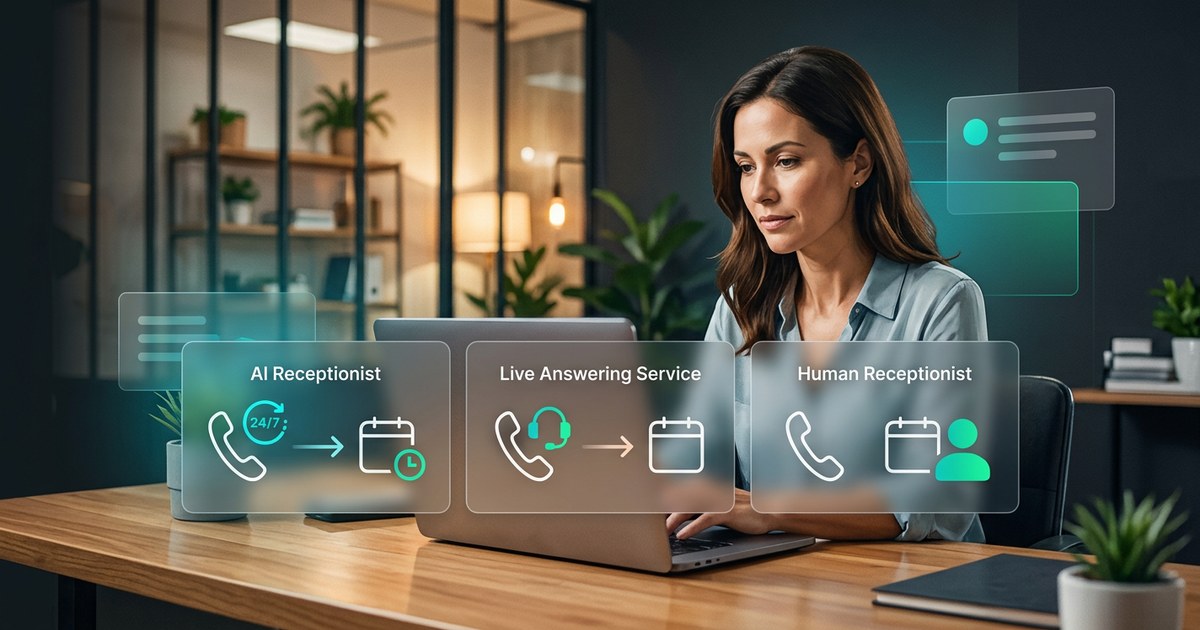
A 24/7 AI receptionist can answer customer calls outside normal office hours, collect accurate details and follow the business’s approved next steps. Reception AI gives Perth and Australian businesses a reliable first response when staff are busy or unavailable, without pretending that every matter can be resolved automatically.
Callers receive immediate acknowledgement, while genuinely urgent, sensitive or complex matters follow the correct escalation pathway.
After-hours callers often have strong intent and may contact a competitor if nobody answers. Reception AI can respond 24/7, identify the reason for the call, gather essential details and arrange the appropriate next action. Clear escalation rules and an accurate business knowledge base are vital.
Why Do After-Hours Calls Matter?
Customers do not always search for a business during normal office hours.
They may look for a tradie after discovering a leak at night, contact a clinic after work, make an enquiry while comparing providers in the evening or call a property service over the weekend.
If the call goes to voicemail, the customer must decide whether to wait. Many will keep searching, particularly when the matter feels urgent or they are ready to book.
A 24/7 response gives the business an opportunity to acknowledge the caller immediately.
Even when the final answer must come from a person, the caller knows what will happen next and the team receives useful information for follow-up.
What Can Reception AI Do After Hours?
Reception AI can follow a different workflow outside ordinary opening times.
Depending on the business, it may:
- Explain that the office is currently closed
- Answer approved general questions
- Capture a new enquiry
- Collect a quote or consultation request
- Take a detailed message for the appropriate team member
- Support booking requests where suitable
- Identify whether a matter meets the business’s urgency criteria
- Provide approved emergency directions
- Confirm when the caller should expect a response
- Send a summary or notification to the appropriate person
The system should never promise an immediate human callback unless the business can genuinely provide one.
Clear expectations build more trust than unrealistic assurances.
Why Are After-Hours Callers So Valuable?
Someone who calls outside business hours may have a strong and immediate need.
They may have just discovered a problem, finished researching their options or reached the point where they are ready to act.
If the business has invested in Google Ads, search engine optimisation, social media or other digital marketing, those campaigns can continue generating enquiries long after the office closes.
An unanswered call creates a gap between attracting a prospective customer and responding to them.
Reception AI helps close that gap by making sure the caller is acknowledged and their enquiry is recorded at the moment of interest.
This does not guarantee a sale, but it protects the opportunity to continue the conversation.
How Should Urgent Calls Be Handled?
“Urgent” means different things in different industries.
A loss of power, a burst pipe, a distressed legal caller and an appointment cancellation all require different responses.
Reception AI should be given precise rules rather than broad instructions.
A robust escalation process defines:
- The words or situations that indicate possible urgency.
- The questions required to understand the immediate circumstances.
- The information Reception AI is permitted to provide.
- Whether the call should be transferred, messaged or referred elsewhere.
- Who should receive an urgent notification.
- What should happen if the designated person does not respond.
For emergencies involving immediate danger, Reception AI should direct callers to the appropriate emergency service according to an approved script.
It should not diagnose a condition, provide professional advice or create false confidence.
Does 24/7 Call Answering Mean Staff Must Be Available All Night?
No. Around-the-clock call answering does not mean a business owner or staff member must respond to every call immediately.
Reception AI can distinguish between matters that can wait until the next business day and those that meet the organisation’s agreed escalation criteria.
A routine quote request received at midnight may be captured for the morning team. A defined urgent matter may trigger a notification or transfer process.
This distinction is important.
The purpose of 24/7 coverage is to give callers an appropriate response at any time. It is not to wake staff unnecessarily or create unrealistic customer expectations.
How Is a 24/7 AI Receptionist Different From Voicemail?
Voicemail records whatever the caller chooses to say.
That may be enough, but it frequently leaves out important details such as:
- The caller’s suburb
- The service required
- The level of urgency
- A preferred appointment time
- The correct spelling of a name
- An alternative contact method
- Whether the person is a new or existing customer
Reception AI can ask follow-up questions and confirm important information during the call.
It can also separate new enquiries from existing customer matters and direct summaries to the appropriate workflow.
The key difference is interaction.
Voicemail stores a monologue. An AI receptionist conducts a controlled conversation designed to reach a defined outcome.
How Is Reception AI Different From a Generic Chatbot?
A website chatbot primarily handles typed conversations on a webpage.
A voice receptionist deals with spoken language, interruptions, different accents, background noise and callers who may change direction during the conversation.
Voice also carries greater expectations. Callers assume the receptionist understands the business and can explain what will happen next.
That makes accurate training, confirmation of important details and carefully defined boundaries essential.
Reception AI is designed around these call-handling needs rather than treating voice as a simple copy of website chat.
What Information Should Be Available Around the Clock?
Begin with business information that remains relatively stable and can be answered safely.
This may include:
- Opening hours
- Office or business location
- Service areas
- Main services
- Appointment or enquiry processes
- What information customers should prepare
- General response-time expectations
- Approved after-hours instructions
- Available contact options
- Basic information about the business
Pricing requires more care.
If fees vary according to the job, location, assessment or service requirements, Reception AI should explain how pricing is determined rather than providing an unreliable figure.
Where exact prices are approved and current, they can be included with any relevant conditions.
Can Reception AI Take Bookings After Hours?
Reception AI can support appointment and booking enquiries where the business’s systems and processes allow it.
Depending on the setup, it may:
- Collect a booking request
- Identify the service required
- Ask for a preferred day or time
- Offer an available appointment
- Confirm an appointment
- Record a cancellation request
- Collect details for an appointment change
- Arrange for staff to confirm the booking
The system should not promise a time unless the appointment has been properly confirmed.
Where direct calendar access is not appropriate, Reception AI can capture the request and explain when a team member will respond.
What Happens When an Existing Customer Calls After Hours?
Existing customers may need a different call flow from new enquiries.
Reception AI can ask whether the caller is an existing customer and collect information such as:
- Their name and contact details
- The service, job or appointment involved
- The reason for the call
- Whether the matter is urgent
- Relevant booking or reference details
- The outcome they are requesting
This helps the morning team distinguish an existing customer matter from a new sales enquiry.
For businesses managing ongoing work, appointments or property matters, this separation can make follow-up much more efficient.
The Midnight Call Test
Imagine a customer calls your business at midnight.
Write down what you would want a highly capable receptionist to do during the first two minutes.
Would they need to:
- Reassure the caller?
- Identify an immediate risk?
- Confirm an address?
- Explain the office’s opening hours?
- Collect information or photographs later?
- Record a preferred appointment time?
- Promise a next-business-day response?
- Contact an on-call team member?
Would your staff genuinely want to be contacted at that time?
This exercise separates “always answering” from “always escalating”.
Reception AI can be continuously available without waking staff for routine matters. The value lies in applying the correct response to each call.
Can a 24/7 AI Receptionist Improve Lead Conversion?
Reception AI can improve the opportunity to convert more leads by ensuring additional callers are acknowledged and captured.
It cannot guarantee that every enquiry will become a customer. Service suitability, pricing, availability and the quality of human follow-up still matter.
Businesses can measure outcomes such as:
- Calls answered after hours
- Qualified enquiries captured
- Appointments or callbacks requested
- Accuracy of customer contact details
- Time taken for staff follow-up
- Common unanswered questions
- Calls that required escalation
- Enquiries that became customers
These measures reveal where the system is adding value and where the workflow needs refinement.
How Can After-Hours Call Data Improve Marketing?
After-hours calls can reveal what prospective customers are searching for and what information they cannot find online.
If callers repeatedly ask about a particular service, location, price or appointment process, the business may need to improve its website content.
Those insights may support:
- New service pages
- Updated frequently asked questions
- More useful Google Business Profile information
- Blog topics based on genuine customer questions
- Clearer Google Ads landing pages
- Better descriptions of service areas
- Improved appointment instructions
Private customer details should never be repurposed carelessly. However, de-identified patterns can reveal valuable gaps in the customer journey.
Reception AI can therefore support more than call answering. It can help a business understand what prospective customers need to know.
How Do You Keep a 24/7 Service Accurate?
A business should nominate someone to take responsibility for the Reception AI knowledge base.
The information should be updated whenever the organisation changes its:
- Opening hours
- Services
- Service areas
- Pricing rules
- Staff contacts
- Appointment processes
- Emergency arrangements
- Policies
- Escalation responsibilities
Call summaries should be reviewed for patterns rather than waiting for a complaint.
If several callers ask the same unanswered question, an approved response may need to be added to the knowledge base.
If callers frequently become confused during a particular step, the wording or sequence may need improvement.
Regular refinement helps Reception AI remain useful as the business changes.
What Should Reception AI Never Do?
A properly configured AI receptionist should operate within clearly defined boundaries.
Reception AI should never:
- Invent information
- Provide unapproved professional advice
- Diagnose a medical or technical problem
- Guarantee an outcome the business cannot control
- Promise an unavailable appointment
- Misrepresent the business’s opening hours
- Treat every matter as an emergency
- Share information outside approved privacy processes
- Continue pretending to understand when important details are unclear
Knowing when to stop and involve a person is one of the most important features of a reliable AI receptionist.
Is 24/7 Reception Suitable for a Small Business?
Yes. Small businesses often benefit from extended call coverage because they have fewer people available to answer the telephone.
Reception AI can be useful when calls arrive:
- During customer appointments
- While staff are on site
- While the owner is driving
- During lunch breaks
- When another caller is already being helped
- In the evening
- Overnight
- On weekends
- On public holidays
The business determines what Reception AI can handle immediately and what should wait for human follow-up.
This provides availability without requiring a small team to operate a fully staffed reception desk around the clock.
Is a 24/7 AI Receptionist Right for Your Business?
A 24/7 AI receptionist is worth considering when after-hours enquiries are valuable, voicemail messages are incomplete or staff regularly miss calls while serving customers.
The best results come from a system that is built around real call types, accurate business information and clearly defined escalation rules.
Reception AI provides around-the-clock availability with business-controlled instructions and human involvement where it matters.
Visit Reception AI or discover more about Reception AI.
Frequently Asked Questions
What is a 24/7 AI receptionist?
A 24/7 AI receptionist is a voice-based service that can answer calls at any time, provide approved information, collect caller details and follow the business’s specified call-handling rules.
Does 24/7 coverage mean staff must be available all night?
No. Routine calls can be recorded for later action, while only matters matching the business’s agreed urgency rules need to be escalated after hours.
Can Reception AI handle emergency calls?
Reception AI can recognise defined urgent scenarios and provide approved directions or escalation. It does not replace emergency services or qualified professional judgement.
Can callers book appointments after hours?
Callers may be able to request or make bookings where the business’s calendar, workflow and integrations support that function.
How do we know what callers asked?
Reception AI can capture approved details and provide a structured summary or notification through the business’s configured workflow.